
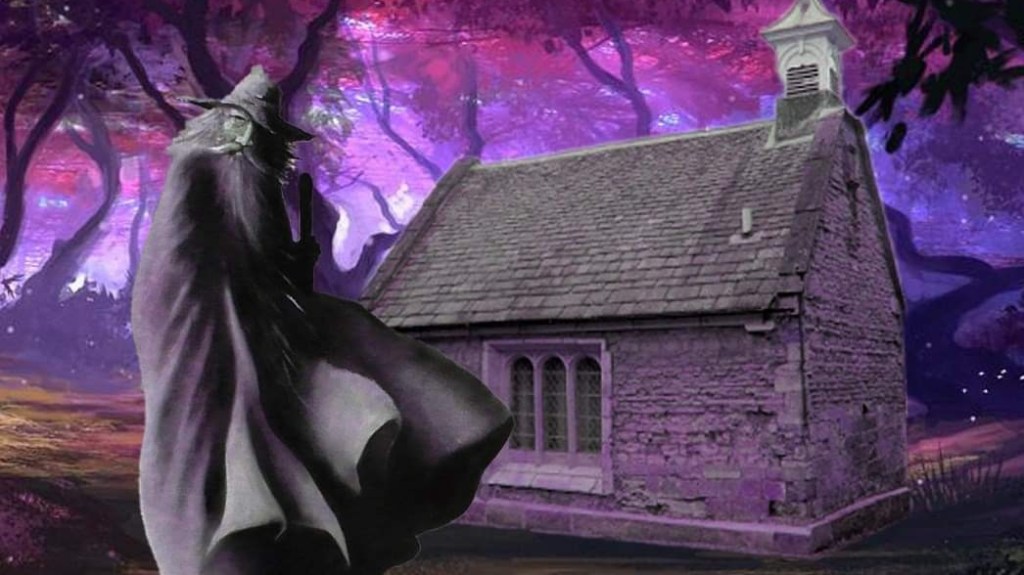
I hadn’t originally intended on writing an entry for this temple, but it’s unique and little known enough that I think it deserves its own post. I found the cover photo for this entry on the Odinist Fellowship Facebook page!
Context!
Once the dominant religion in Britain, Odinism was brought over from Scandinavia by a certain group of warriors in boats and flourished for some time. The Norse pantheon, consisting of deities like Thor, Odin and Freyja, were worshipped across much of Northern Europe. In addition, Odinism entailed a belief in giants, dwarves, elves, a giant World Tree named Yggdrasil and the future apocalyptic battle of Ragnarok.
The Norse faith (and every other form of paganism in the UK) eventually died out in the medieval era. However in the early 20th century, modern revival efforts began, forming a new religion based on surviving texts from the Viking era. The number of Odinists in the UK has grown quite substantially over the past few decades, to the point that there’s now a physical place of worship for them. The first temple in modern times was opened in 2014, in the market town of Newark-on-Trent.
I came here in part because I was curious about what it was like inside, but mostly to support a good friend of mine who was looking for a neopagan group to associate themselves with. We arranged a visit for one Saturday, meeting with Ralph, one of the temple priests. I was curious to find out why they’d decided to open a temple in a town more famous for its English Civil War history than anything related to the Vikings, and what attracts people to the Odinist belief system.
Our experience was definitely enlightening, albeit tainted with some information that we found after our visit – but I’ll get into this later. For now, let’s discuss what it’s like to actually visit the Newark Odinist Temple.
The Experience
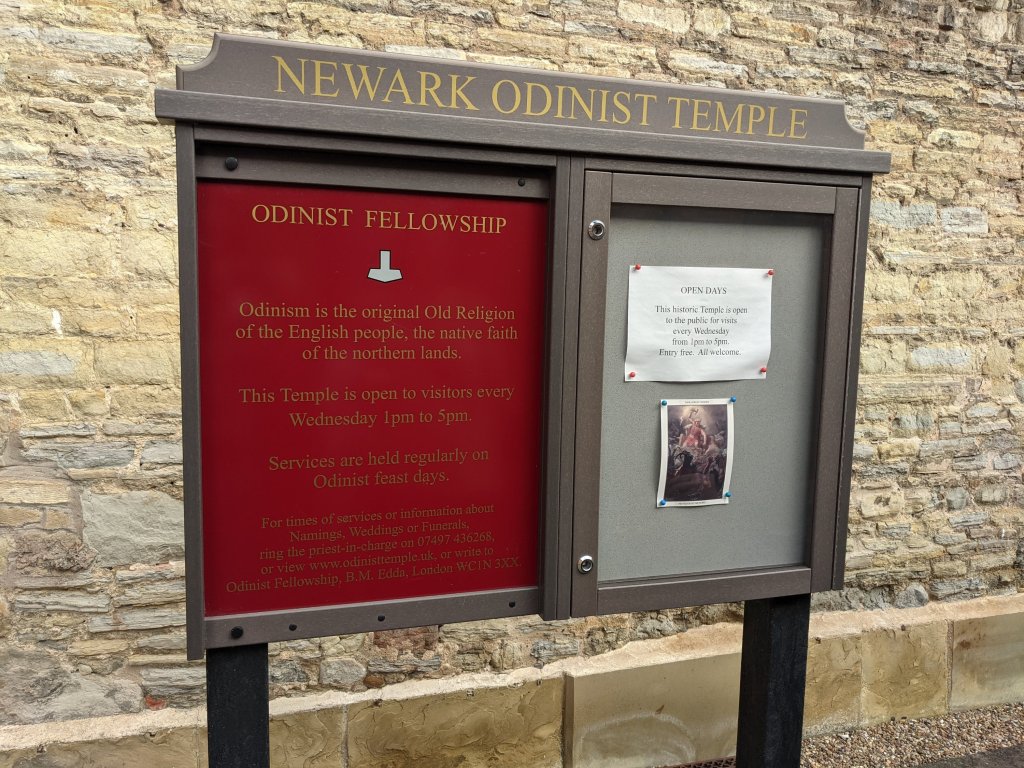
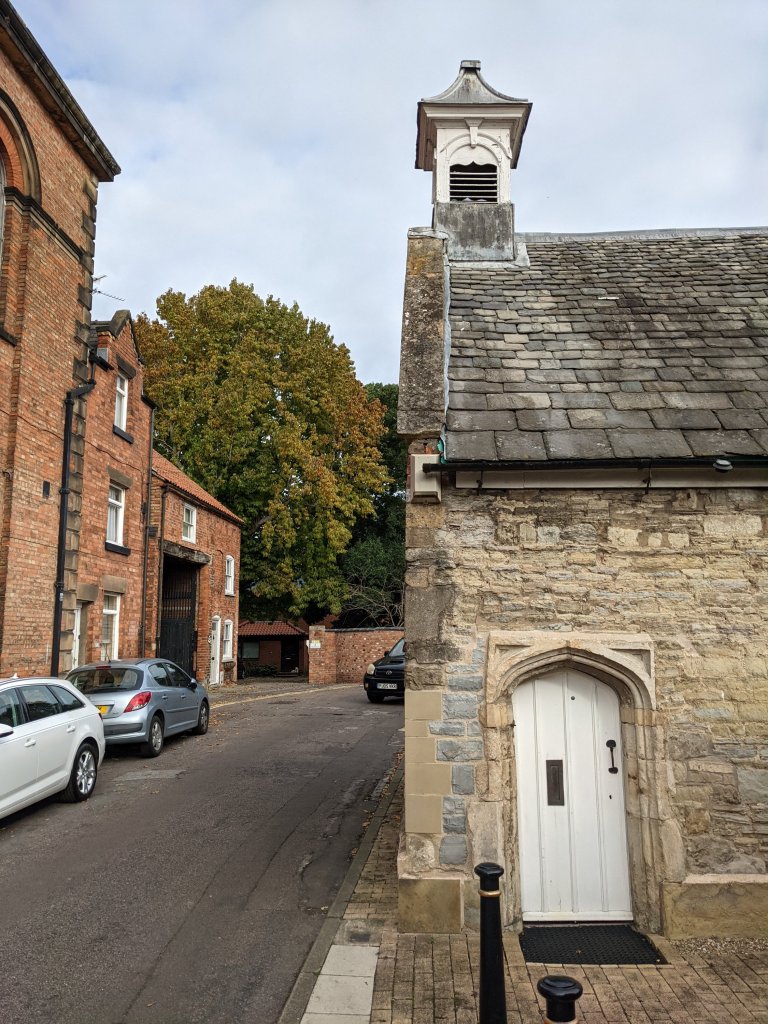
Newark isn’t a big place, and the temple is not hard to find. It’s only a stone’s throw away from the main square, and the building itself is next to a big Methodist church that’s hard to miss. Interestingly the Temple is surrounded by compact little houses – it’s not really the sort of place you’d expect to see people worshiping Norse deities.
We knew that the site wouldn’t be big, but we were amazed at how tiny this building really is! A former almshouse chapel, the entire Odinist temple really is about the size of my living room. While we waited for Ralph to arrive we amused ourselves by doing laps around the chapel, which takes about five seconds.
Ralph turned up around 12pm as agreed – I’m endlessly grateful that he gave up his Saturday afternoon to show us around. Once inside, we sat down and Ralph gave us a brief overview of the Odinist faith, answering some of the questions we had.
I learned that the location was partially picked because it’s so central – a temple in the North would be a problem for devotees based in London, and vice versa – but also because the building was on the market and there wasn’t much competition for such a small, ancient building. Apparently their only real bidding rivals were the Quakers.
Mid-conversation, another Odinist adherent suddenly appeared. A middle-aged military veteran, he mostly sat and listened, but occasionally interjected with some commentary about why he joined the faith. Apparently the concept of Valhalla in particular strongly appealed to him as a former soldier. At one point he proudly showed us his Thor’s hammer pendant (which in retrospect might have been a red flag – more on this later).
My friend and Ralph discussed some religious matters, which was of course the main reason we were there but also a very personal matter for her. But let’s focus on the temple itself. How was this former chapel changed into an Odinist place of worship?
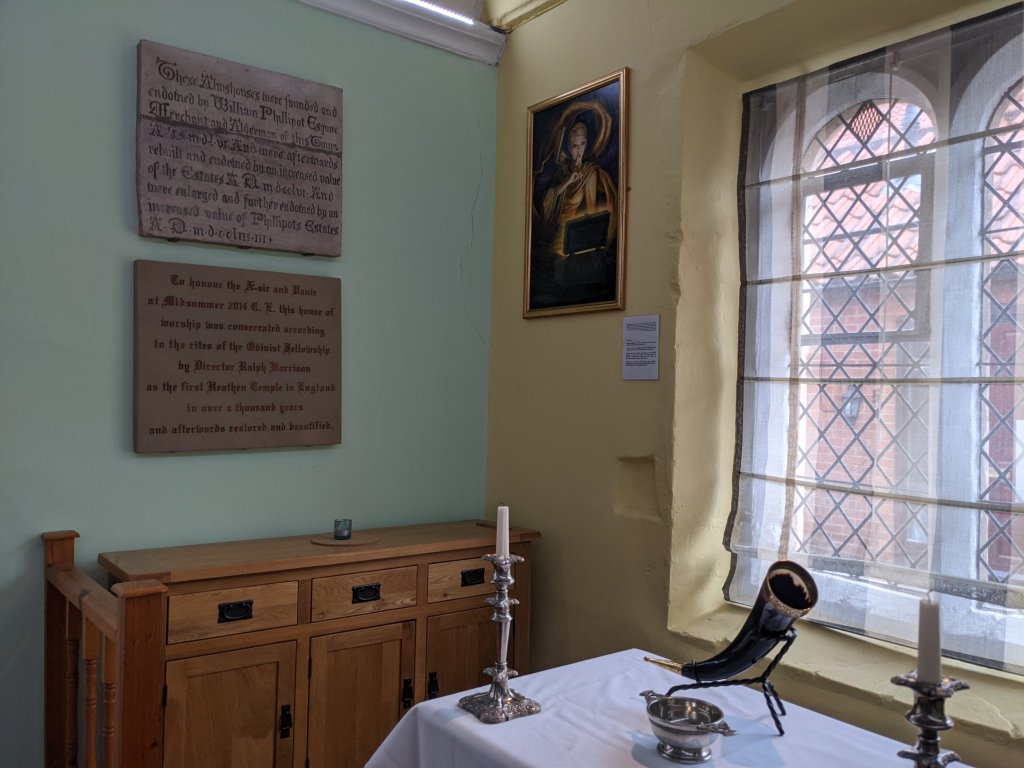
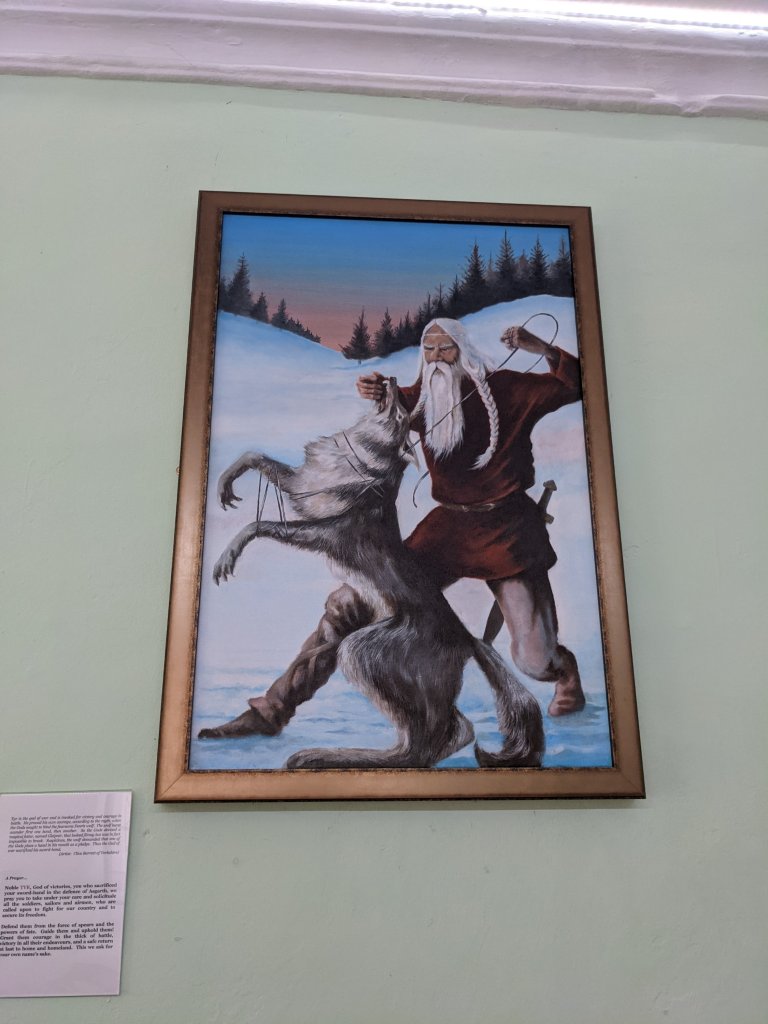
Well, there’s no radical changes. Ralph explained that as the chapel was so old (I think Grade 2 listed) that the changes they could make were very limited, and the local council has proved difficult to work with. But nonetheless the fellowship has made it very cosy. The walls, for example, have paintings of the major Odinist deities, each painted by a different artist. Thor is depicted as he was by the Norse, with a red beard and riding a chariot pulled by two goats. Odin is shown as a Gandalf looking figure (Ralph’s words). I particularly liked this one of Tyr wrangling Fenrir the wolf.
There’s also some bookshelves, including a little library of Norse texts, and some religious texts for sale. My eyes were drawn to the Thor’s hammer that had been coloured in by a child – I asked if the fellowship had a sort of Sunday School equivalent. Apparently there’s no regular gathering just children in Odinist families, but some members bring their kids to temple events and efforts are made to explain the religion’s tenants to them. It seems much easier to keep the attention of children with stories about Ragnarok and Loki than most other religious figures. Can you imagine making the life of Joseph Smith exciting for eight year olds?
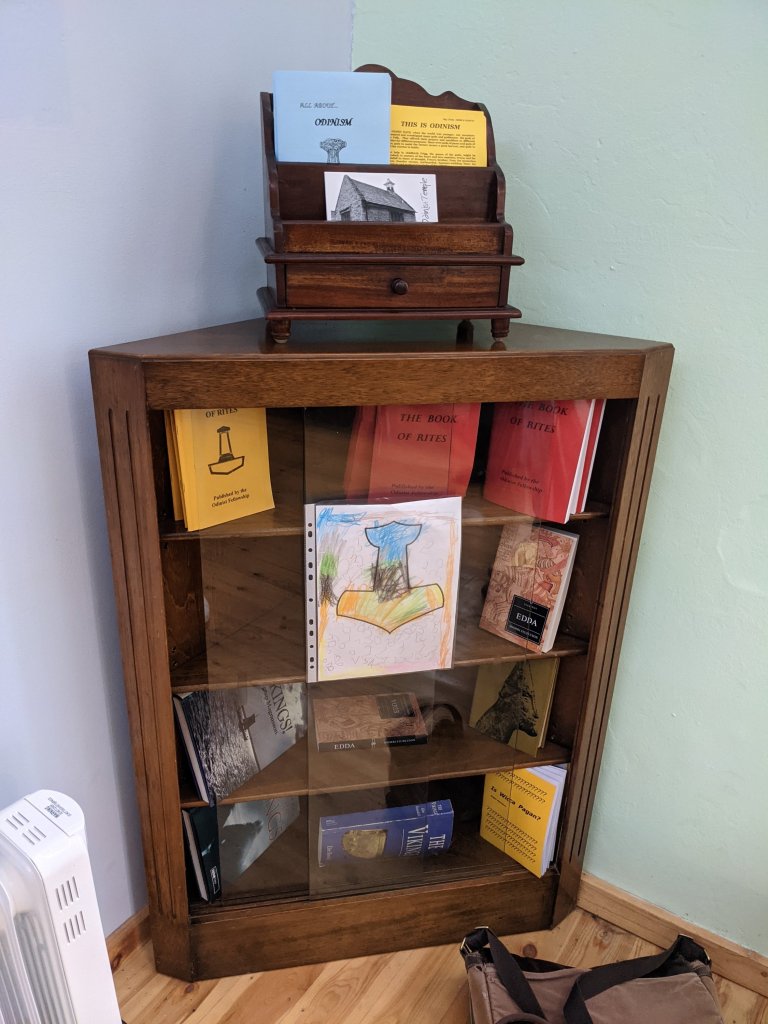
Otherwise there’s very little else in the building. I think I appreciate the minimalist approach. The Fellowship could have gone all “heavy metal” and plastered the chapel with runestones, wolf heads and Norse helmets – but besides the paintings and drinking horn centrepiece on the altar, there’s very little in the building that screams “Viking”. Far from fetishizing the past, the Odinist Fellowship seems eager to present itself as a belief system that’s compatible with the modern world.
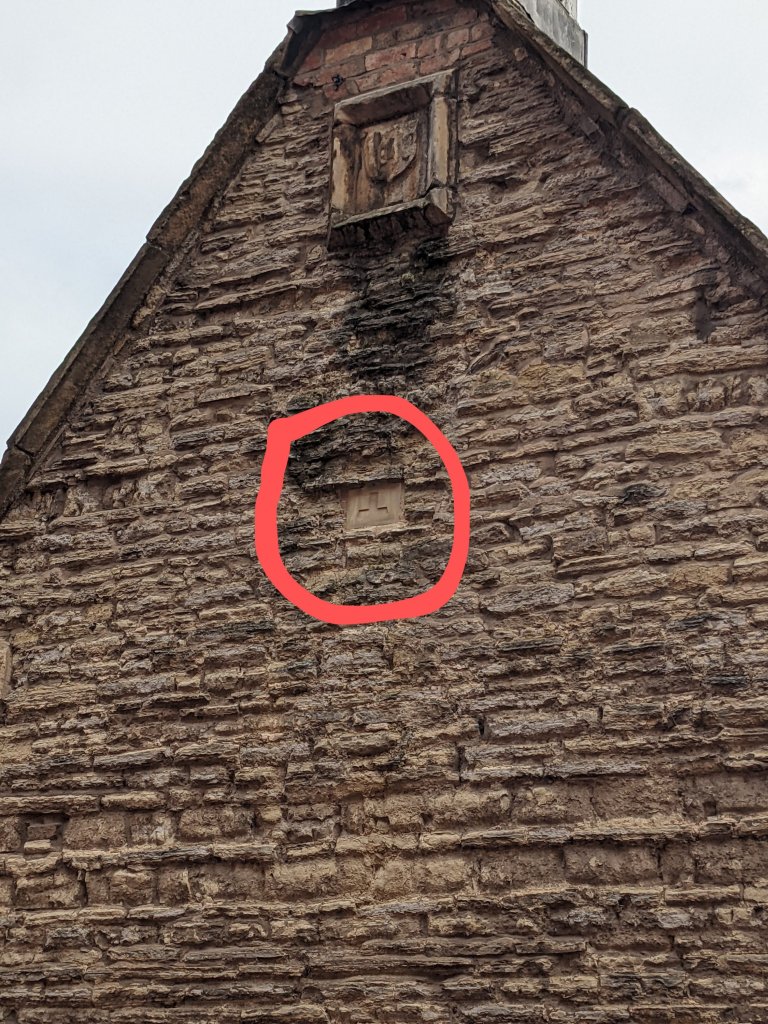
After about an hour spent chatting away, we bid our goodbyes and headed back into Newark. Before we left, Ralph pointed out the sole modification they’d made to the outside of the building. A brick on the side was missing, so a new one with an Odinist hammer was crafted, and used to fill in the gap.
We walked off for some coffee and to discuss what we’d learned. Later we also stopped off at the Newark Civil War Museum – it’s not really offbeat, so I didn’t review it, but it’s really interesting and did give me the chance to take this photo. Newark is a quirky little town!

How was it?
The Newark Odinist Temple isn’t a must see attraction. I’d hesitate to call it a tourist sight at all, if the temple didn’t open itself to the public every week. The building itself is cute but not exactly vast, and other than the cool Norse paintings there’s nothing to really see. However it’s unique in the UK (for now), and the adherents seem very open to answering any questions you might have about their new (or old, depending on your viewpoint) belief system.
But anyway, time to discuss the… less than ideal information we found out about Odinism. After our visit, my neopagan friend did some more research on the Odinist temple, and found some slightly eyebrow-raising aspects about their views on who can and can’t join the coven. According to their own literature, only those who have “Norse heritage” (i.e. white) are allowed to join. This quickly led to some frantic discussions between me and her on whether this was a deal breaker or not.
The awkwardness of the situation is that similar policies exist for many ethno-religions and it’s not something I’d normally challenge. It’s not possible (or extremely difficult) to convert to Zoroastrianism, Orthodox Judaism or some forms of Hinduism. But also these groups (generally) don’t seek out converts. The impression we got from the Odinists is that they’d be happy for us to convert… if we were white.
I suppose you could argue that “Norse Heritage” is separate from “white”, but being as the Vikings spread across most of Europe in their time I’m not sure how far they’d take this. What does Norse heritage actually mean? The Vikings reached afar as Russia, North Africa and Baghdad after all, and there’s probably some level of Norse DNA in these populations – Could someone from Morocco or Iraq join the Odinist temple?
I should be clear that during our conversation Ralph made his hatred of the Nazis and their abuse of Norse iconography very clear – without being prompted, no less. I don’t think Ralph was a raging white supremacist at all. Still, my friend (who, I should add, is white) was discomforted enough by this revelation that she’s instead looking at more inclusive Neopagan groups. If I’d known this going in I would have asked about how strict they are with this requirement.
Odinism in particular has had a problem with being associated with far right White Nationalist groups – in some contexts, Thor’s hammer can even be considered a hate symbol – something I did consider when the adherent we talked to very proudly showed his pendant off. While the temple was very kind and accomodating to our group, we were also all white and one of us was considering converting. I’m not at all claiming that the Newark Odinist Temple is a hate group (or I wouldn’t be writing about them!), but I felt that I couldn’t in good conscience not discuss this issue. Personally I hope they have a change of heart. Ultimately however, whether this policy is a deal-breaker or not is up to you.
Problematic issues aside, the Newark Odinist Temple is a fairly rare example of a dedicated Neopagan place of worship that’s open to the public. Keep your expectations in check and consider giving it a look if you’re curious about the state of religion in modern Britain.
Useful Information
- The Odinist Temple website can be found here. They also have a relatively active Facebook page here.
- Although we arranged a private visit, if you’d like to pop in unannounced, the Newark Odinist Temple is open every Wednesday from 1-5pm. Visits are obviously free.
- Alternatively if you want to arrange a visit ahead of time, you can find the contact details of the Temple here. I emailed them but got no response, but I was able to phone them up and arrange a visit pretty easily.
- It’s a really small building and not an actual tourist attraction, so there’s no facilities like toilets. However it’s in the centre of Newark so anything you need is probably nearby.
- The little bookshelf has some postcards and booklets on Odinist beliefs you can buy, if you have cash on you.
- If you’re getting the train to Newark-on-Trent, there are two train stations for the relatively small town. Either one isn’t far from the town centre fortunately. Newark Castle station is right next to the pretty castle ruins so in a pinch if probably recommend that station.
 ☕🐸Coffee Frog Travel Blog🐸☕
Leave a comment